Tuesday, February 23, 2010

Google's New Aardvark - Move aside Facebook

Afterlaunching Buzz last week, Google have continued on the social track by now acquiring social search service Aardvark.

The deal, rumoured to be worth around $50 million, could see Google use the social search engine as an answer to, well, Yahoo! Answers. Through IM, Twitter and e-mail, Aardvark lets you ask full-text questions and then takes your social connections and attempts to identify the best person within your network (or extended network - friends and family) who might be able to assist in giving that answer.

Here is how Wired explains the concept behind Aardvark:

Users who sign up give (Aard)Vark access to one of their social networks - Facebook, LinkedIn or the e-mails in their contact list. Users then say what things they are confident answering questions about (e.g. chess, cooking, country music). Vark then routes future questions - such as what's the best country band out of the south from the 1970s or where's a good sushi restaurant near Santa Monica - to the right person. A series of algorithms keeps tuning the targeting by watching if a user's answers are quick and useful, deciding whether their friends are also experts, and checking if a user is online or has been asked to answer too many questions recently.

The news was confirmed by Aardvark CEO (and ex-Googler) Max Ventilla who emailed TechCrunch with the following: "We can confirm that Google has signed a deal to acquire us but have no further comment."

So I'm afraid that's all the news we have so far folks, but if we hear anything more, we will be sure to let you know.

Technorati : , , ,
Del.icio.us : , , ,
Zooomr : , , ,
Flickr : , , ,

Thursday, February 11, 2010

Foreclosures and Short Sales - Which one would you like ?

Find Foreclosures Across the Country

Foreclosures: What Are They?

Foreclosure occurs when a bank repossesses a property because the owner fails to pay the mortgage. Foreclosure is not a quick process, however. Usually, foreclosure occurs when the homeowner, or borrower, misses several payments. This is called a default and starts the foreclosure process. Banks and homeowners have several options when faced with foreclosure. The home can be sold in a pre-foreclosure sale or short sale, can go to auction, or can be taken over by the financial institution and become a bank owned property (REO).

How Do Foreclosure Sales Work?

Pre-Foreclosure Sales

In a pre-foreclosure sale, a property may be bought from the homeowner of the financial institution holding the mortgage prior to the start of the foreclosure process. Generally, the seller is relieved of financial liability and the buyer is able to obtain a house at or below market value.

Auction

Some banks may place a foreclosed property into an auction to try and regain the lost amount on the defaulted property. The price for an auctioned house may begin at the outstanding amount of the mortgage, and any buyer of an auctioned property will often have to take possession of the property in an "as is" state.

REO (Bank Owned Property)

If the auction fails to attract any bids, the property may be assumed by the bank and become an REO property. If this happens, the bank will list the REO property with a brokerage, like RealEstate.com, REALTORS®, and attempt to sell the bank owned property as a normal real estate transaction. However, the bank may be willing to simple recoup the loss on the foreclosed loan.

How Can Buyers Benefit?

Buyers can obviously benefit from buying foreclosures at deep discounts off market value. Buyers may also look at foreclosed properties as investment opportunities. Buying a foreclosed property often means the buyer must be able to pay with cash and it is important that the buyer understand the local laws surrounding foreclosures and REOs. To find out more about Foreclosures, Pre-Foreclosures - visit http://www.robertjrussell.com

Technorati : , , , ,
Del.icio.us : , , , ,
Zooomr : , , , ,
Flickr : , , , ,

Saturday, February 06, 2010

Search the MLS!

Are you looking for a house?

Complete MLS Search Engine FREE to you. Get new listings emailed to you the day they go on the market. Ask me how to set this up for you.

http://www.ntreisinnovia.net/cgi-ntr/BR_login?0479382

Technorati : , , ,
Del.icio.us : , , ,
Zooomr : , , ,
Flickr : , , ,

Wednesday, January 20, 2010

A Fresh Look at Financial Security

Tips for Sound Preparation in a Not-So-Sound Economy

We've seen a lot over the last few years. From the collapse of the housing market to large financial institutions closing their doors, our economy is going through unprecedented change. If this state of flux has you wondering about your financial future, we urge you to read on. A little insight and a lot of helpful advice await you.

Our Experts
Enter Terrence Meyer, Jr. and Ed Conarchy.

Meyer is a financial representative for the Strategic Financial Group, Northwestern Mutual, in Los Angeles.

He asserts that for Northwestern Mutual, the goal is not to find the hottest new product. Instead, the philosophy is one of long-term and conservative approach, something he ascribes to as well when he works with clients.

Ed Conarchy is a nineteen-year veteran of the mortgage industry outside the Chicago area. He is also the founder of National Advisors Network, a registered investment advisory firm, and part of the Mortgage Success Source Faculty. Wearing two hats allows Conarchy to give both mortgage and investment advice holistically, something he sees as the future of financial planning.

"As a mortgage planner I was constantly being asked about both," Conarchy explains. Considering the fact that mortgage advisors have access to client information such as income, credit score, taxes and assets, Conarchy felt it made sense to bridge the gap by earning his investment advisor credentials.

The State of the Economy
Over the last several years, people have seen that economic conditions, as well as the housing market, can change quickly.

When asked about his thoughts on rebuilding the economy, Meyer believes it would take a very long time. In his words, "The playing field has changed, and it's not done changing."

Conarchy agrees with Meyer's sentiment. Relating it to the subject of the housing crisis, he says the drop in home values and the overly large inventory of foreclosures are not going away overnight.

Meyer believes that more accountability and government scrutiny are sure to come, something he sees as being positive, but hopes will not have unintended negative effects. While he believes more stringent barriers need to be put in place in order to prevent this type of collapse from happening again, he says it would have to be done in a way that does not "crimp the engine that makes the economy go."

Conarchy feels that while a correction in the supply and demand of homes needs to take place, another necessary component to preventing any further collapse in the housing market is a change in how we view our mortgages and our homes.

"We've always been taught our home is one of our greatest investments," says Conarchy. "And the key to financial security was our ability to pay our mortgage down as quickly as possible." The problem, however, is that the paradigm for financial freedom has changed.

Mr. Conarchy says that while lenient loan requirements started the ball rolling with the housing crisis, what got many people in trouble was they bought too big of a house. According to Conarchy, the idea of buying a home with the intention of selling it at a higher price when the time calls is the equivalent of putting the majority of your money into one stock.

Unfortunately for many people, occurrences such as layoffs, injuries, or the inability to refinance an adjustable rate mortgage put them in a position where they could no longer afford their home. For any potential home buyer, Conarchy suggests they go into it, "Planning for the worst and hoping for the best."

Conarchy believes you should start by looking at a home as the place where you live, as opposed to the investment that is going to bring you financial freedom. Look for a home you can afford if times were to get tough, and at that point search for the best long-term loan you can find. After you purchase your home, concentrate less on paying off the mortgage and more on using any non-essential income for the following goals: saving for retirement, paying off high interest/non tax-deductible debt, creating a 12-month fixed-expense rainy day fund or investing into diversified investments that carry some form of liquidity.

Mr. Meyer believes there are two perspectives every family and business owner should focus on.

The first is offense, or the use of your income directed at financial goals such as buying a home, sending a child to college, and ensuring a comfortable retirement. The second is defense, which beckons the following question: in the event of injury, layoff, or premature death, what measures can you put in place to protect against the interruption of your financial goals? According to Meyer, not having adequate insurance coverage and retirement resources are examples of his point.

While these two methods should go hand in hand, Meyer says for many people it is difficult to strike the right balance and they become entangled. The role of a financial professional is to help clients untangle these priorities, understand their individual needs, and provide them with solutions in conjunction with sound principles and expert advice.

Speaking of the individual, we asked our experts about the financial concerns of their clients.

"It's all about trust," Meyer claims, referring to their trust in him and his company. People want to know that the company helping them achieve financial security will likely be there in the long haul when the need is realized.

Mr. Conarchy says for his clients during this recent downturn, "It's been all about going upside-down on their mortgage." But, he claims that type of worry only occurs when people view their home as an investment, rather than a residence. He urges us to think of our homes like we do our cars, choosing them for lifestyle and need, not as our investment accounts.

The way Meyer sees it, balancing your offense and defense is more important than ever before. It's all about taking personal responsibility for your financial security.

"The myth," Meyer says, "is many people think they will need less income at retirement. The reality is they would want to maintain their same lifestyle and often experience little change in expenditures."

Parting Advice
Meyer suggests meeting with an educated and experienced individual (or team) to do a needs analysis for your family or business. It is also important to work with a strong company and do your research on financial strength.

The key here is to start and take action. Review your goals periodically and stay vigilant about your preparation. The objective is to remove the emotion from your financial decision making. In doing so, you are taking a step forward to securing your financial security.

Conarchy urges people to not give away their liquidity by prepaying their mortgage. Instead of focusing on debt elimination, turn your efforts toward wealth accumulation, but without trying to predict the future of the market.

"Manage your mortgage," says Conarchy. Make sure you have a competitive rate and that you are paying it on time. Don't think of your mortgage as the lump sum bank debt. Rather, think of it as a monthly bill. In terms of refinancing, pay attention to the net monthly after-tax savings in relation to what the refi will cost and how long it will take to break even. If the refi can pay for itself in less than one year then it's a good deal.

Conarchy wrapped things up by stating you should have one major goal with your personal finance - obtaining financial security. This he says has nothing to do with not having a mortgage payment. If you can't sell your home or get money out of it when you need to then what good is it? "I'd much rather have a big mortgage and a big bank account than no mortgage and nothing in my bank account," he claims.

"Our parents didn't have investing tools like IRAs, 401Ks and 529s like we do," says Conarchy. All they knew was to use their house as an investment, so paying it off made sense. He points out that the rules have changed, but somehow the mantra didn't. "Always remember," he says, "Banks will never loan you money when you really need it."

Technorati : , ,
Del.icio.us : , ,
Zooomr : , ,
Flickr : , ,

Friday, January 15, 2010

Cup of Coffee Pork Roast

Recipe For January!

It's a cup of joe -- as in java -- that brings this poignant pork roast to life. To say it's brewing in goodness would be an understatement.

Main Ingredient
Cooking Method
Difficulty
Course/Dish
Makes
6-8 servings
1 Cup of Coffee Pork Roast
Created by The MDM Team, Sunday, 17 February 2008
It's a cup of joe -- as in java -- that brings this poignant pork roast to life. To say it's brewing in goodness would be an understatement.
Ingredients
3 lb. pork roast, trimmed of fat
1 tbsp. vegetable oil
1/4 cup soy
sauce
1 cup coffee
2
bay leaves
1 clove garlic, minced
1/2 tsp. oregano
2 onions, sliced
Additional coffee and soy sauce as needed

Methods/steps
  1. Preheat oven to 300 degrees.
  2. Heat oil in large skillet over high heat, and then sear meat on both sides. In a large roasting pan, combine one onion and remaining ingredients. Transfer browned meat to roasting pan and top with second onion.
  3. Cover and bake 3 1/2 to 4 hours. Baste every hour with juices. If liquid begins to boil away, add more coffee or soy sauce as needed. Use pan juices to make gravy. Use no salt.
Additional Tips
Ready in 4 hours
For more information about Food - Visit http://www.robertjrussell.com - you won't find any recipes on this site - but I think you might like it!

Technorati : , , ,
Del.icio.us : , , ,
Zooomr : , , ,
Flickr : , , ,

Thursday, January 14, 2010

How do you Motivate Yourself ?

A long time ago, my exercise routine consisted of walking daily. I felt that my body was ready to kick it up a notch. The gym was suggested to me. I wasn't crazy about it initially, but decided to give a try. I realized after a couple of visits that I actually liked it.

I knew that one of my initial challenges would be to commit going to the gym regularly. How would I go about doing this? I knew that I wanted to motivate myself … or perhaps coach myself. So I defined goals and incentives (e.g. rewards) for achieving those goals. For instance, one reward was that for each week I would go the gym, I would purchase songs from iTunes. Listening to the new songs on my iPod, while exercising, not only felt great, but also motivated me to continue my exercise commitment.

What are some ways that you motivate yourself? I would be interested to get your feedback, thanks.

Technorati : , , ,
Del.icio.us : , , ,
Zooomr : , , ,
Flickr : , , ,

Saturday, January 09, 2010

Government health insurance option appears doomed

WASHINGTON - Senior House Democrats have largely abandoned hopes of including a government-run insurance option in the final compromise health care bill taking shape, according to several officials, and are pushing for other measures to rein in private insurers.

House Speaker Nancy Pelosi and other senior Democrats told President Barack Obama in recent meetings they want the legislation to strip the insurance industry of a long-standing exemption from federal antitrust laws, officials said. That provision is in the House-passed measure, but was omitted from the bill that the Senate passed on Christmas Eve.

They also want the final measure to include a House-passed proposal for a nationwide insurance exchange, to be regulated by the federal government, where consumers could shop for private coverage. The Senate bill calls for a state-based system of exchanges.

Additionally, House Democrats want to require insurers to spend a minimum amount of premium income on benefits, thereby limiting what is available for salaries, bonuses, advertising and other items. The House bill sets the floor at 85 percent; the Senate-passed measure lowers it to 80 percent for policies sold to small groups and individuals.

The officials spoke on condition of anonymity because the negotiations are private.

The maneuvering comes as the White House and majority Democrats intensify efforts to agree on a final measure, possibly before Obama delivers his State of the Union address late this month or early in February.Government intervention into the insurance market is one of the most contentious issues to be settled. Others include the fate of a Senate-passed tax on high-cost insurance plans, bitterly opposed by some labor unions; the extent to which abortions could be covered by insurance to be sold in the new exchanges; and the amount of money available to help lower-income families purchase coverage.

Liberals long have pressed to include a government-run insurance option in the legislation, arguing it would create competition for private companies and place a brake on costs.

House Democrats included it in their legislation. In the Senate, it drew opposition from Democratic moderates whose votes are essential to the bill's fate. Even attempts to include an expansion of Medicare for uninsured individuals as young as age 55 - widely viewed as a face-saving proposal for liberals - had to be jettisoned.

Given the opposition in the Senate, Pelosi, D-Calif., signaled late last year she did not view a public option as a requirement for a final compromise. Asked in an interview Dec. 16 whether she could support legislation without it, she said, "It depends what else is in the bill."

More recently, she listed her goals for a House-Senate compromise without mentioning the provision she long has backed.

"We are optimistic that there is much that we have in common in both of our bills and that we will resolve or reconcile this legislation in a way that is a triple A rating: affordability for the middle class, accountability for the insurance companies, and accessibility to many more people in our country to quality, affordable health care," she said.

While Obama favors a government option, he has said repeatedly it is only a small part of his overall effort to remake the health care system, and is not essential.

Pelosi and Senate Majority Leader Harry Reid, D-Nev., have expressed optimism about chances for a swift agreement, but there appears to be relatively little maneuvering room. That is particularly true in the Senate, where 60 votes will be needed to overcome a Republican filibuster, and any change carries the risk of alienating a Democrat whose vote is crucial.

The bill's future is further complicated by a scheduled Jan. 19 election in Massachusetts. Some polls show Democrat Martha Coakley in a closer-than-expected race against Republican Scott Brown and an independent contender. The winner will replace Sen. Paul Kirk, who became the 60th member of the Democratic caucus when he was named to his seat as successor to the late Sen. Edward M. Kennedy.A Republican upset would deprive Democrats of their 60th vote.

Some House Democrats say the proposed government insurance option remains alive, although they speak publicly of its possible demise as long as insurance companies aren't let off the hook.

California Rep. Xavier Becerra, who's on the leadership team, said House members would only be willing to abandon the public plan if they were certain the final bill achieves the goals they want, as Pelosi described.

"We're willing to give up what's good for America as long as we get something good back," he said.

Rep. Chris Van Hollen of Maryland, also a member of the leadership, agreed.

"I think the House is very much of a view that before they'd consider dropping the public option" they have to be assured of a bill that achieves the goals they wanted the public option to meet.

But officials said little if any time has been spent in White House meetings on the issue, and there was scant discussion of it during a conference call for members of the Democratic rank and file earlier this week.

Technorati : , , ,
Del.icio.us : , , ,
Zooomr : , , ,
Flickr : , , ,

Thursday, January 07, 2010

Start your own Social Network

Many people ask me how I get so much business....and it is a very simple answer but you may not believe it but I have my own Social Network.

Some people use Facebook, LinkedIn, MySpace etc - I use the Robert J Russell Social Network

If you would like to join the Robert J Russell Social Network - simply click on this link:

http://robertjrussellsocialnetwork.ning.com/profiles/members/


Come Join us today !!

Robert J Russell - 972-679-9029

Technorati : , , ,
Del.icio.us : , , ,
Zooomr : , , ,
Flickr : , , ,

Wednesday, January 06, 2010

Obama backs high-end health plan tax

WASHINGTON - President Barack Obama signaled to House Democratic leaders Wednesday that they'll have to drop their opposition to taxing high-end health insurance plans to pay for health coverage for millions of uninsured Americans.

In a meeting at the White House, Obama expressed his preference for the insurance tax contained in the Senate's health overhaul bill, but largely opposed by House Democrats and organized labor, Democratic aides said. The aides spoke on condition of anonymity because the meeting was private.

House Democrats want to raise income taxes on high-income individuals instead and are reluctant to abandon that approach, while recognizing that they will likely have to bend on that and other issues so that Senate Majority Leader Harry Reid, D-Nev., can maintain his fragile 60-vote majority support for the bill.

House Speaker Nancy Pelosi and four committee chairmen met with the president Wednesday as they scrambled to resolve differences between sweeping bills passed by the House and Senate. The aim is to finalize legislation revamping the nation's health care system in time for Obama's State of the Union address early next month.

Despite the dispute over the payment approach, Pelosi, D-Calif., emerged from the meeting expressing optimism.

"We've had a very intense couple of days," Pelosi said. "After our leadership meeting this morning, our staff engaged with the Senate and the administration staff to review the legislation, suggest legislative language. I think we're very close to reconciliation."

Congressional staff members stayed at the White House into the evening to continue work, and a conference call of the full House Democratic caucus was scheduled for Thursday. Obama is taking a more direct role than ever, convening Oval Office meetings Tuesday and Wednesday of House Democratic leaders.

The House and Senate bills are alike in many ways. Both impose first-time requirements for almost all Americans to purchase health insurance, providing subsidies for lower- and middle-income people to help them do so, though the subsidies in the House bill are more generous. Both establish new marketplaces called exchanges where people can go to shop for and compare healthinsurance plans. Both would ban unpopular insurance company practices including denying coverage to people with pre-existing health conditions.

Differences include whom to tax, how many people to cover, how to restrict taxpayer funding for abortion and whether illegal immigrants should be allowed to buy coverage in the new markets with their own money. The House bill covers about 36 million uninsured Americans over 10 years, costing more than $1 trillion, while the cheaper Senate bill covers about 31 million.

House Democrats are steeling themselves to abandon establishment of a new government insurance plan opposed by moderates in the Senate, but in return hope to get the Senate to rescind insurers' antitrust exemption, make subsidies more affordable and agree to establishment of national rather than state health insurance exchanges, among other things. Obama has signaled his support for the House position on the subsidies and other areas, aides said.

The difference in how the bills are paid for is emerging as among the toughest disputes.

The House wants to increase income taxes on individuals making more than $500,000 and couples over $1 million, which would raise $460 billion over 10 years to pay for the bill. The Senate wants to tax insurance companies on plans valued at over $8,500 for individuals and $23,000 for couples, raising $150 billion. Most analysts say the insurance tax would be passed on to consumers, and organized labor is strongly opposed, as are House Democrats, some of whom contend that the tax would violate Obama's campaign pledge not to tax the middle class.

"We did in our house bill something that protects middle class Americans from having to pay more for health insurance," Rep. Xavier Becerra, D-Calif., a member of the House leadership, said Wednesday. "So far we want to stay to that principle."

House members "have been very clear on that issue and working with the president to stick to what he said when he was campaigning for president, we're trying to make sure this does not affect middle class Americans," Becerra said.

Obama has defended the tax as a way to drive down health costs.

"I'm on record as saying that taxing Cadillac plans that don't make people healthier but just take more money out of their pockets because they're paying more for insurance than they need to, that's actually a good idea, and that helps bend the cost curve," the president said in an interview with National Public Radio just before Christmas. "That helps to reduce the cost of health care over the long term. I think that's a smart thing to do."

In the end the House likely will have to accept the insurance plan tax at some level - say starting with plans valued at $25,000 or more, with carve-outs for certain union professions - but it might not happen without a fight.

A provision in the Senate bill to increase the Medicare payroll tax on high-earners could provide some middle ground, although that measure would raise only $87 billion over a decade.

By ERICA WERNER, Associated Press Write

(This version CORRECTS that Obama's State of the Union address to be early next month.)

Technorati : , , , , , , , , ,
Del.icio.us : , , , , , , , , ,
Zooomr : , , , , , , , , ,
Flickr : , , , , , , , , ,

Tuesday, January 05, 2010

Avoid Home Damage from Frozen Pipes

Texas Department of Insurance

AUSTIN - Texas weather can change quickly, especially in the winter. A fast-moving cold front can cause temperatures to drop below freezing within hours. Outdoor pipes, pipes in unheated areas, and pipes that run along uninsulated exterior walls can burst if the water in them freezes and expands. This can shatter pipe seals or the pipes themselves, sending water pouring through your house. You can avoid thousands of dollars of damage to your walls, ceilings, carpets, and furniture by taking a few simple measures to protect your home.

Before the Freeze

·Protect faucets, outdoor pipes, and exposed pipes in unheated areas by wrapping them with rags, newspaper, trash bags, or plastic foam.

·Insulate your outdoor water meter box and be sure its lid is on tight.

·Cover any vents around your home's foundation.

·Drain and store water hoses indoors.

·Protect outdoor electrical pumps.

·Drain swimming pool circulation systems or keep the pump motor running. (Run the pump motor only in a short freeze. Running the motor for long periods could damage it.)

·Drain water sprinkler supply lines.

·Open the cabinets under sinks in your kitchen and bathrooms to allow heated indoor air to circulate around the water pipes.

·Set your thermostat at a minimum temperature of 55 degrees, especially when you're gone for the day or away for an extended period.

·Let indoor faucets drip; it isn't necessary to run a stream of water.

·Make sure you know where your home's shut-off valve is and how to turn it on and off.

·If you leave town, consider turning off your water at the shut-off valve while faucets are running to drain your pipes. Make sure you turn the faucets off before you turn the shut-off valve back on.

·If you drain your pipes, contact your electric or gas utility company for instructions on protecting your water heater.

If Your Pipes Freeze

·If a pipe bursts and floods your home, turn the water off at the shut-off valve. Call a plumber for help if you can't find the broken pipe or if it's inaccessible. Don't turn the water back on until the pipe has been repaired.

·If the pipe hasn't burst, thaw it out with an electric heating pad, hair dryer, portable space heater, or towel soaked with hot water. Apply heat by slowly moving the heat source toward the coldest spot on the pipe. Never concentrate heat in one spot because cracking ice can shatter a pipe. Turn the faucet on and let it run until the pipe is thawed and water pressure returns to normal.

·Don't use a blowtorch or other open-flame device. They are fire risks and carbon monoxide exposure risks.

If You Have a Loss

·Contact your insurance agent or company promptly. Follow up as soon as possible with a written claim to protect your rights under Texas ' prompt-payment law.

·Review your coverage. Most homeowners and renters policies pay for property repair. In addition, most policies pay for debris removal and for additional living expenses if you have to move temporarily because of damage to your home. If you can't find your policy, ask your agent or company for a copy.

·Home owner's policies may require you to make temporary repairs to protect your property from further damage. Your policy covers the cost of these repairs. Keep all receipts and damaged property for the adjuster to inspect. If possible, take photos or videos of the damage before making repairs. Don't make permanent repairs. An insurance company may deny a claim if you make permanent repairs before an adjuster inspects the damage.

·Most home owner's policies do not cover loss caused by freezing pipes while your house is unoccupied unless you used reasonable care to maintain heat in the building; shut off the water supply; and drain water from plumbing, heating, and air conditioning systems.

* Visit http://www.robertjrussell.com for any Real Estate related questions

* Visit http://www.InsurancePricedRight.com for any Insurance related questions.


Technorati : , , ,
Del.icio.us : , , ,
Zooomr : , , ,
Flickr : , , ,

Tuesday, December 29, 2009

Texas study confirms lower autism rate in Hispanics

Hispanic kids are less likely than their non-Hispanic white counterparts to be diagnosed with autism, and socioeconomic factors don't seem to explain the difference, according to a new study in Texas schoolchildren.

"These findings raise questions: Is autism under diagnosed among Hispanics? Are there protective factors associated with Hispanic ethnicity?" Dr. Raymond F. Palmer of the University of Texas Health Science Center in San Antonio and his colleagues write in the American Journal of Public Health.

Other research has shown a lower risk of autism among Hispanic individuals, while one study found that Hispanics with autism were typically diagnosed later than autistic children of other ethnic backgrounds. Autism could be under diagnosed among Hispanics, Palmer and his team note, given that these children are less likely to have health insurance and more likely to have trouble accessing medical care.

To investigate the factors behind the difference in prevalence, the researchers looked at data on 1,184 schools in 254 Texas counties, calculating the number of children in kindergarten through 12th grade in each district who had been diagnosed with autism.

For every 10 percent increase in Hispanic schoolchildren in a given district, the researchers found, the prevalence of autism decreased by 11 percent, while the prevalence of kids with intellectual disabilities or learning disabilities increased by 8 percent and 2 percent, respectively.

The reverse was seen as the percentage of non-Hispanic white children in a district increased, with the prevalence of autism rising by 9 percent and the prevalence of intellectual and learning disabilities falling by 11 percent and 2 percent.

The observed relationships remained for Hispanic children after the researchers accounted for key socioeconomic and health care provider factors, although "urbanicity" of a district, median household income, and number of health care professionals did explain the increased percentage of autism among districts with more non-Hispanic white kids -- a finding the researchers call "curious."

Whether lower autism prevalence in Hispanics is attributable to other, still-unexamined socioeconomic, health care delivery or biological factors "remains a crucial area for further research," Palmer and colleagues conclude.

SOURCE: American Journal of Public Health, December 2009.

http://www.robertjrussell.com

Technorati : , ,
Del.icio.us : , ,
Zooomr : , ,
Flickr : , ,

Monday, December 21, 2009

How to hide files in .JPEG Pictures

If you're looking to hide files on your PC hard drive, you may have read about ways to encrypt folders or change the attributes on a file so that they cannot be accessed by prying eyes. However, a lot of times hiding files or folders in that way requires that you install some sort of software on your computer, which could then be spotted by someone else.

I've actually written quite a few articles on how you can hide files and folders in Windows XP and Vista before, but here I'm going to show you a new way to hide files that is very counter-intuitive and therefore pretty safe! Using a simple trick in Windows, you can actually hide a file inside of the JPG picture file!

You can actually hide any type of file inside of an image file, including txt, exe, mp3, avi, or whatever else. Not only that, you can actually store many files inside of single JPG file, not just one! This can come in very handy if you need to hide files and don't want to bother with encryption and all that other technical stuff.

Hide File in Picture

In order to accomplish this task, you will need to have either WinZip or WinRAR installed on your computer. You can download either of these two off the Internet and use them without having to pay anything. Here are the steps for creating your hidden stash:

  • Create a folder on your hard drive, i.e. C:\Test and put in all of the files that you want to hide into that folder. Also, place the image that you will be using to hide the files in.hide file in jpg
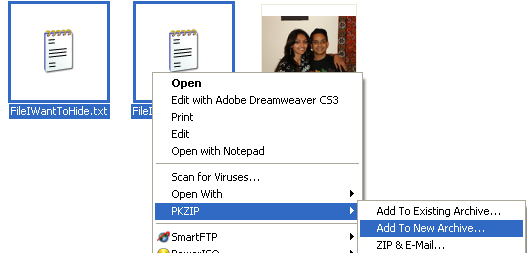
  • Now select all of the files that you want to hide, right-click on them, and choose the option to add them to a compressed ZIP or RAR file. Only select the files you want to hide, not the picture. Name it whatever you want, i,e. "Hidden.rar".

add to archive

  • Now you should have a folder that looks something like this with files, a JPG image, and a compressed archive:

hidden rar

  • Now here's the fun part! Click on Start, and then click on Run. Type in "CMD" without the quotes and press Enter. You should now see the command prompt window open. Type in "CD \" to get to the root directory . Then type CD and the directory name that you created, i.e. "CD Test".

cd test

  • Now type in the following line: "copy /b DSC06578.JPG + Hidden.rar DSC06578.jpg" and press Enter. Do not use the quotes. You should get a response like below:

hide files in jpg

Just make sure that you check the file extension on the compressed file, whether it is .ZIP or .RAR as you have to type out the entire file name with extension in the command. I have heard that some people say that they have had problems doing this with a .ZIP extension, so if that doesn't work, make sure to compress to a .RAR file.

And that's it! The picture file will have been updated with the compressed archive inside! You can actually check the file size of the picture and see that it has increased by the same amount as the size of the archive.

You can access your hidden file in two ways. Firstly, simply change the extension to .RAR and open the file using WinRAR. Secondly, you can just right-click on the JPG image and choose Open With and then scroll down to WinRAR. Either way, you'll see your hidden files show up that you can then extract out.

winrar

That's it! That is all it takes to hide files inside JPG picture files! It's a great way simply because not many people know it's possible and no one even thinks about a picture as having to the ability to "hide" files. Enjoy!

For information: Visit http://www.robertjrussell.com

Technorati : , ,
Del.icio.us : , ,
Zooomr : , ,
Flickr : , ,

Tuesday, December 08, 2009

If Danny Cahill Wins the Biggest Loser, Bunn-O-Matic Corporation ® Will Donate up to $25,000 Worth of Coffee Brewers to Charity

BUNN, a leader in beverage equipment, is pleased to announce that if Danny Cahill is named The Biggest Loser champion, they will donate a home coffee brewer for every pound he loses to a non-profit hunger relief organization. Danny owns a BUNN home coffee brewer and the company wants to show their support for his inspirational weight loss journey.

Springfield, IL (PRWEB) December 6, 2009 -- BUNN, a leader in beverage equipment, is pleased to announce that if Danny Cahill is named The Biggest Loser champion, they will donate a home coffee brewer for every pound he loses to a non-profit hunger relief organization.

BUNN GRX-B Home Coffee Brewer

But why Danny and not one of the other contestants?

BUNN is committed to our customers and wants to recognize Danny as an inspiration of what is possible when you are committed to a goal

Contact:
Lisa McCloud, Director of Marketing, Retail Division
Bunn-O-Matic Corporation
800-352-2866
http://www.bunn.com

Lisa McCloud, Director of Marketing, is a fan of the show and has been following Danny's weight loss progress throughout Season 8. During episode 812, she saw that Danny has a BUNN coffee brewer in his home in Broken Arrow, Oklahoma. "As a fan and a BUNN employee, I was very excited to see that Danny owns one of our coffee brewers!" commented Ms. McCloud. "His success this season has been a true testament to hard work and dedication. These are qualities that we admire and that represent the products and services that we provide to our customers. We want to do something to support Danny in his final push to the finale and are guessing that he will lose between 225 - 250 pounds. That equates to up to $25,000 worth of coffee brewers that could be donated."

"BUNN is committed to our customers and wants to recognize Danny as an inspiration of what is possible when you are committed to a goal" said Aimee Markelz Tracy, Senior VP Retail Division. "We're excited to see the finale and wish Danny the best of luck."

About BUNN

Bunn-O-Matic Corporation (BUNN) is a pioneer in the beverage equipment industry. BUNN was founded in 1957 and built on innovations including the first flat-bottom paper coffee filter for commercial use and the first pourover coffee brewer. Today, BUNN continues to innovate commercial beverage equipment and home coffee brewers from its global headquarters in Springfield, Illinois and provides comprehensive service to customers throughout the world. For more information, please visit www.bunn.com or call 1-800-637-8606 or +1-217-529-6601. Find us on Facebook at http://facebook.com/BUNN or follow our news on Twitter at http://twitter.com/BUNN.

To find out about Real Estate or Insurance visit: http://www.robertjrussell.com

Technorati : , , , , ,
Del.icio.us : , , , , ,
Zooomr : , , , , ,
Flickr : , , , , ,

Tuesday, December 01, 2009

Thursday, November 26, 2009

Videos

Videos

Are you shopping on Black Friday ?

NOT ME - but I am going to do it all online and make money on my own purchases - you can too - Sign up to Blastoff - it's free !!

Hundreds of Retail stores online that PAY YOU $$$$$$ to shop here!

http://my.blastoffnetwork.com/viralvideo/223487891

http://www.robertjrussell.com

Robert J Russell, IRES, REALTOR, Broker

Technorati : , , ,
Del.icio.us : , , ,
Zooomr : , , ,
Flickr : , , ,